Cycle time
- 90%
- 90%
Eliminated 100%
Unlocked real-time
Drastically reduced
Behind the prestige of brands like Dom Pérignon lay a fragile operational reality: business strategy teams depended on manual CSV exports and disjointed tools.
My mandate was to dismantle this legacy process and rebuild it as a custom web application suite on SAP HANA. The goal was not just migration, but a complete workflow overhaul to improve data reliability and introduce advanced forecasting capabilities.
The existing workflow presented a significant business risk. Estimating champagne unit demand required users to switch between multiple tools, constantly exporting and importing data.
File corruption and metric conversion failures were common, meaning a single human error could skew global stock predictions. We needed a system that ensured data integrity while maintaining user flexibility.
SAP HANA is a powerhouse for data processing but notoriously rigid for frontend customization. Standard interfaces are often cluttered and counter-intuitive.
To overcome these limitations, I had to bridge the gap between design intent and technical feasibility. I spent weeks auditing SAP documentation to understand the environment’s parameters, allowing me to push the framework to its limits without breaking it.
We implemented two key strategic shifts:
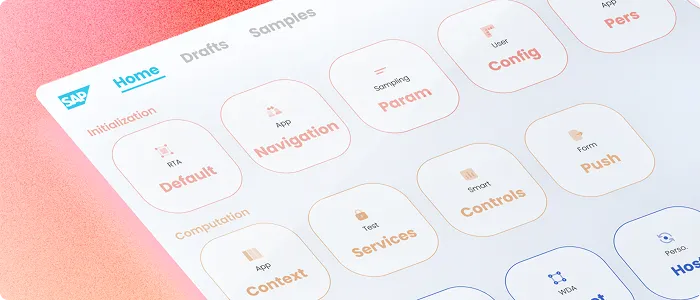
Modular linearity: We decomposed the monolithic spreadsheet process into specialized tools (Financial, Stock, Context) with automated data flow. This architecture enabled real-time scenario modeling—previously impossible with CSVs.
The emergency exit: Legacy ERPs often trap users in rigid linear processes. Leveraging Nielsen’s heuristics, we engineered “emergency exits” allowing users to undo actions or retreat without data loss, fostering confidence in exploration.
Transitioning from a disjointed file system to an integrated app suite drastically reduced stock strategy cycles. Tasks that consumed days were completed in hours.
Beyond speed, we delivered intelligence. The new environment provided LVMH strategists with unprecedented flexibility and reliability. This project reinforced the value of technical empathy: understanding developer constraints was key to designing a solution that was not just visually compliant, but shippable and robust.